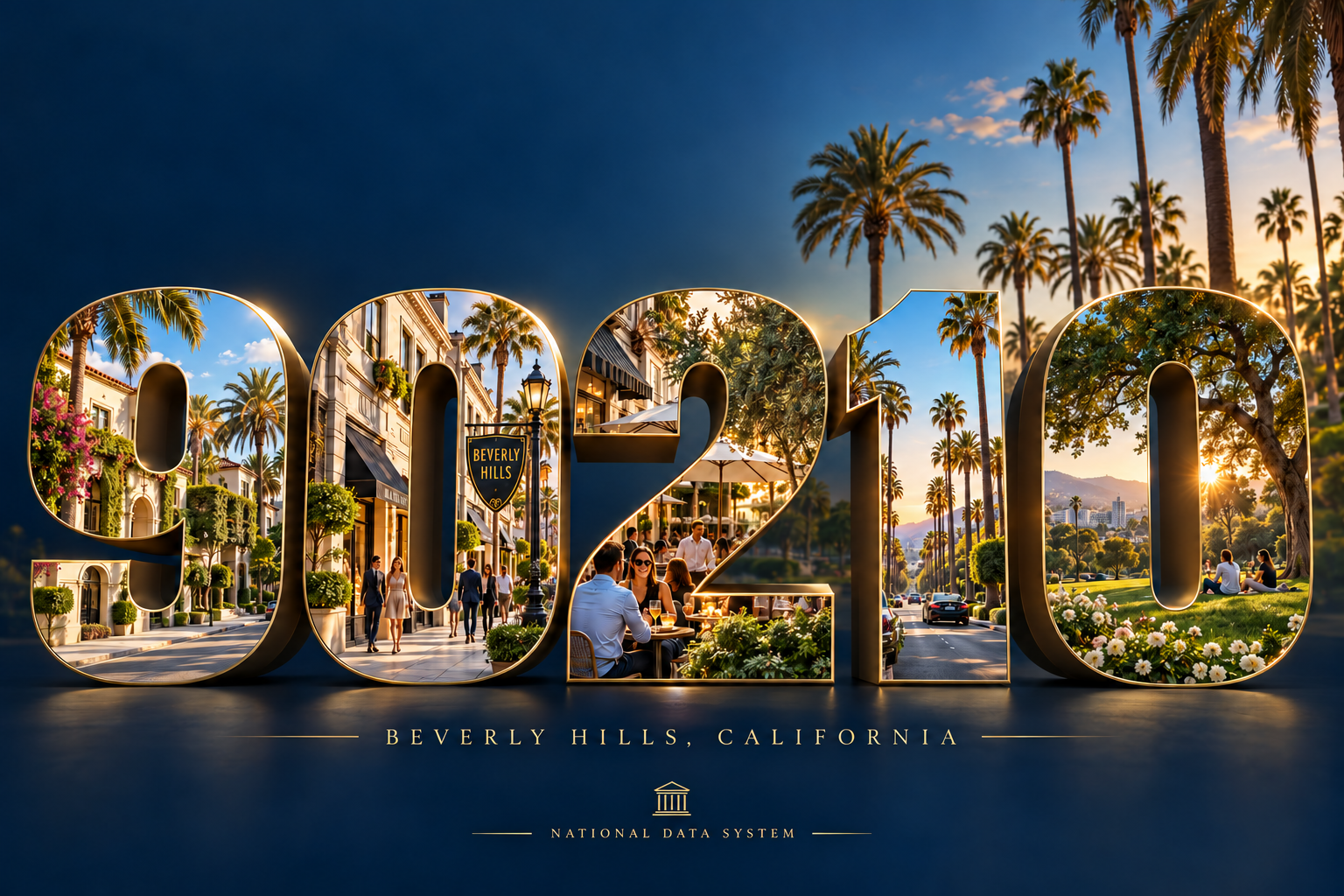
An address becomes an idea
Before a dataset tells us about a place, a story may already have shaped what we expect to find there. For many people, the numbers 90210 call up a world of glamour, youth, friendship, and ambition. That cultural image is an entry point for asking a deeper question: how much of what we believe about a community comes from the people who live there, and how much comes from the stories told about them?
The original Beverly Hills, 90210 premiered on October 4, 1990. Its opening premise followed Brandon and Brenda Walsh, twins newly arrived from Minnesota, trying to find their footing at fictional West Beverly High. Their arrival gave the audience an outsider’s perspective on an unfamiliar social world. [3]
Read sociologically, that setup makes the setting more than scenery. Moving into a new place means encountering expectations: how to dress, whom to trust, what success looks like, and who appears to belong. The Walshes’ adjustment offers a way to consider how communities teach newcomers their unwritten rules.
How the show was designed to invite insight
Creator Darren Star described wanting a teen drama that treated young people’s experiences honestly. In his Television Academy interview, he explained that the series would center teenagers dealing with their own problems rather than parents resolving those problems for them. He also connected its culture-shock premise to his experience moving to California for college. [1]
That is documented creative intent. The sociological interpretation developed here is that this design invites viewers to look beneath appearances: choices emerge within friendships, families, schools, and social expectations. Its characters and conflicts made those pressures visible through drama.
Writer-producer Larry Mollin later described the creative team’s attention to emotional continuity and to earning an audience’s response through the buildup of scenes. [4] That approach helps explain why following the same characters over time can make a social issue feel like part of a life rather than a disconnected lesson.
What the setting helps us notice
Belonging has unwritten rules
A place can be physically open while its social circles are harder to enter. Friendship, recognition, and acceptance are resources of their own. The useful question is not simply who lives in a ZIP code, but how people find a place within its institutions and relationships.
Wealth and emotional life meet in the same place
The show’s affluent setting gave its friendship and family conflicts a particular tension: economic advantage and emotional security are different dimensions of life. Housing and income help describe the material setting; friendship and family stories reveal the emotional pressures within it.
Peers and institutions shape choices
Young people make decisions within networks of friends, family expectations, and school life. The show’s documented topics included learning disabilities, prejudice, divorce, sexuality, and substance use. [2] These themes invite questions about which pressures people face and which forms of support are available.
Place becomes a symbol
Five digits can acquire meanings that extend far beyond mail delivery. A cultural image can create expectations about status or lifestyle before we encounter a community ourselves. The sociological insight is that a place can carry a reputation before we experience it ourselves.
The impact—and the people outside the frame
The show’s influence extended beyond weekly storylines. UCLA’s profile of Star describes 90210 as an international sensation and places his work within a broader shift toward dramas centered on different stages of life. [5] The Television Academy’s series history records fashion influence, fan activity, and viewers writing to Brenda for personal advice. [2] These examples show how the series reached beyond its weekly storylines and into popular culture.
Its reach also makes representation worth examining. The same Academy history discusses criticism of a predominantly white, affluent screen world and limited portrayals of people outside it. [2] A series can invite important conversations while leaving experiences at the margins.
For this site, the question is who appears in the story—and who must be sought elsewhere. Workers, older adults, households with different resources, cultural communities, and residents beyond the main characters’ circles all belong in a fuller investigation of place. Their presence and circumstances in the real 90210 area must be established through evidence, rather than assumed from television.
THE NUMBERS BEHIND THE CULTURAL IMAGE
The wealth behind the image: what the numbers reveal.
Beverly Hills, 90210 invited America into a world associated with wealth, desirable homes, social status, and opportunity. National Data System’s records let us explore the material setting behind that image: housing values, household income, ownership, and business activity, alongside employment and retirement income.
Research and data: National Data System. This feature brings together 90210 records for housing, income, business activity, employment, retirement income, and mortgage access. Source dates and measurement details appear with the evidence.
Housing, income, and business life
The resident footprint recorded in National Data System’s 90210 profile.
Household earning power adds another dimension to the economic story.
Zillow source observation: February 28, 2026. Housing value connects the area’s material setting with its cultural image.
2023 ZIP Code Business Patterns: employer business locations in the area’s commercial footprint.
Owner-occupied units divided by occupied housing units, with reconciled source counts.
This separate Census housing measure is listed as unavailable in the source record.
The $5,952,438 Zillow source value gives the show’s emphasis on desirable housing a concrete point of connection with the NDS evidence. Housing is part of how wealth becomes visible in a place: through the homes, streets, and settings that shape its public image. The observation used here is dated February 28, 2026.
The 2,536 employer establishments recorded for 2023 add a commercial dimension to that setting. The community’s story includes places where people work and services that support daily life. That gives us a bridge from the show’s social world to the wider business economy around it.
Employment and retirement: two different populations
The 2024 ACS five-year estimates describe 2020–2024 for native Census ZCTA 90210. They add a multi-year view of labor-force participation and household income sources.
| Measure | Published rate | Numerator / denominator |
|---|---|---|
| Unemployment | 5.19% | 468 unemployed / 9,017 civilian labor-force participants |
| Households receiving retirement income | 15.13% | 1,215 / 8,029 households |
The unemployment measure describes civilian labor-force participants; the retirement-income measure describes households. Together, they widen the economic portrait to include participation in work and receipt of retirement income, while retaining their separate populations.
The show placed teenagers at the center of the story. NDS expands the conversation to include working lives and households receiving retirement income, giving us additional ways to explore the community behind the famous address.
Mortgage access: a separate, modeled context
The mortgage records provide weighted area estimates for activity year 2024, using tract-to-ZIP RES_RATIO weights. They introduce financing access as another part of the housing story.
| Measure | Reported value | Meaning |
|---|---|---|
| Approval-rate level | 66.43% | 2024 weighted approvals / decisioned applications |
| Denial-rate level | 33.57% | 2024 weighted denials / decisioned applications |
| Denial-rate change | +0.35 percentage points | 2024 minus 2023 source rate; not percent growth |
The rates reconcile against 527 source-weighted decisioned applications, rounded for display. The approval and denial levels describe the modeled area context; the change describes movement between the 2023 and 2024 source rates.
What the story and the records can tell us together
The screen image: glamour and advantage
The evidence: a housing-value source field and a recorded ownership rate offer material context.
The better question: how do housing ownership, values, and earning power contribute to the area’s image of wealth?
The screen image: a world centered on youth
The evidence: employment and retirement-income measures introduce other dimensions of household life.
The better question: what is the real age and household mix?
The screen image: friendship and belonging
The evidence: economic conditions provide the setting in which people build friendships, families, and social connections.
The better question: how do people experience connection, and whose accounts will help us understand it?
The screen image: a recognizable Beverly Hills identity
The evidence: the NDS place profile brings together Beverly Hills as primary locality with Beverly Glen and Los Angeles geographic labels.
The better question: which geography does each measure describe? The source uses several geographic labels; each measure needs to be read at its stated geographic scale.
This is the value of bringing story and evidence together: the show’s image of wealth gives us a familiar starting point, and NDS opens that image into a richer account of housing, business, employment, and community life.
Read the source dates and measurement details
Employment: existing Move + PositionForLove 2024 ACS foundation; B23025_005E / B23025_003E × 100. Employed complement: 8,549. Numerator count margin of error: 199; denominator count margin of error: 845.
Retirement income: 2024 ACS B19059 original native ZCTA archive; B19059_002E / B19059_001E × 100. Complement: 6,814. Numerator count margin of error: 244; denominator count margin of error: 485.
Uncertainty: source count margins of error accompany the Census counts; derived-rate margins of error are not included in these records.
Geography: native Census ZCTA estimates, postal ZIP records, and weighted mortgage context use different geographies. Los Angeles city/county and Los Angeles–Long Beach–Anaheim metro appear as browsing labels in the source.
Periods: employment and retirement 2020–2024; employer establishments 2023; mortgage activity 2024, with a separate 2023 comparison rate; Zillow source observation February 28, 2026. Population, income, and ACS housing: reference periods are unspecified in the source records.
Zillow source detail: observation February 28, 2026; exact series definition under review.
Source coverage: unavailable fields remain labeled as unavailable.
More ways to understand 90210
Age, ancestry, birthplace, language, household structure, and historical evidence offer further perspectives on 90210. Pairing each measure with its period will help us explore how the community’s story has developed across generations.
A QUESTION TO CARRY WITH YOU
When you hear a ZIP code, how much comes from its cultural image—and what changes when you examine the evidence?
Sources & editorial approach
Creator and producer accounts explain the show’s creative intentions. Institutional histories document its cultural influence. National Data System provides the geographic and economic evidence for this article’s sociological interpretation.
- Television Academy: Foundation Archive—Darren Star. October 5, 2016. Creator interview on the premise, teenage agency, and culture shock.
- Television Academy Interviews: Beverly Hills, 90210. Series history discussing social issues, audience culture, and representation criticism.
- Television Academy: Brian Austin Green retrospective. Premiere, opening premise, and reflections on the show’s development.
- Larry Mollin: writer-producer interview. Published on Mollin’s website; discusses emotional continuity and storytelling during the college years.
- UCLA School of Theater, Film and Television: Darren Star. Institutional profile describing the show’s international and cultural reach.
- National Data System: ZIP 90210 place profile. Geographic and population context used in this feature.
- National Data System / Most Wealthy ZIPs: 90210 housing, income, business, employment, retirement-income, and weighted mortgage records. Source dates and definitions accompany the measures.
Independent commentary on the original Beverly Hills, 90210 series. The feature illustration was generated for this website. National Data System’s records connect the cultural story with the economic and geographic setting of 90210.